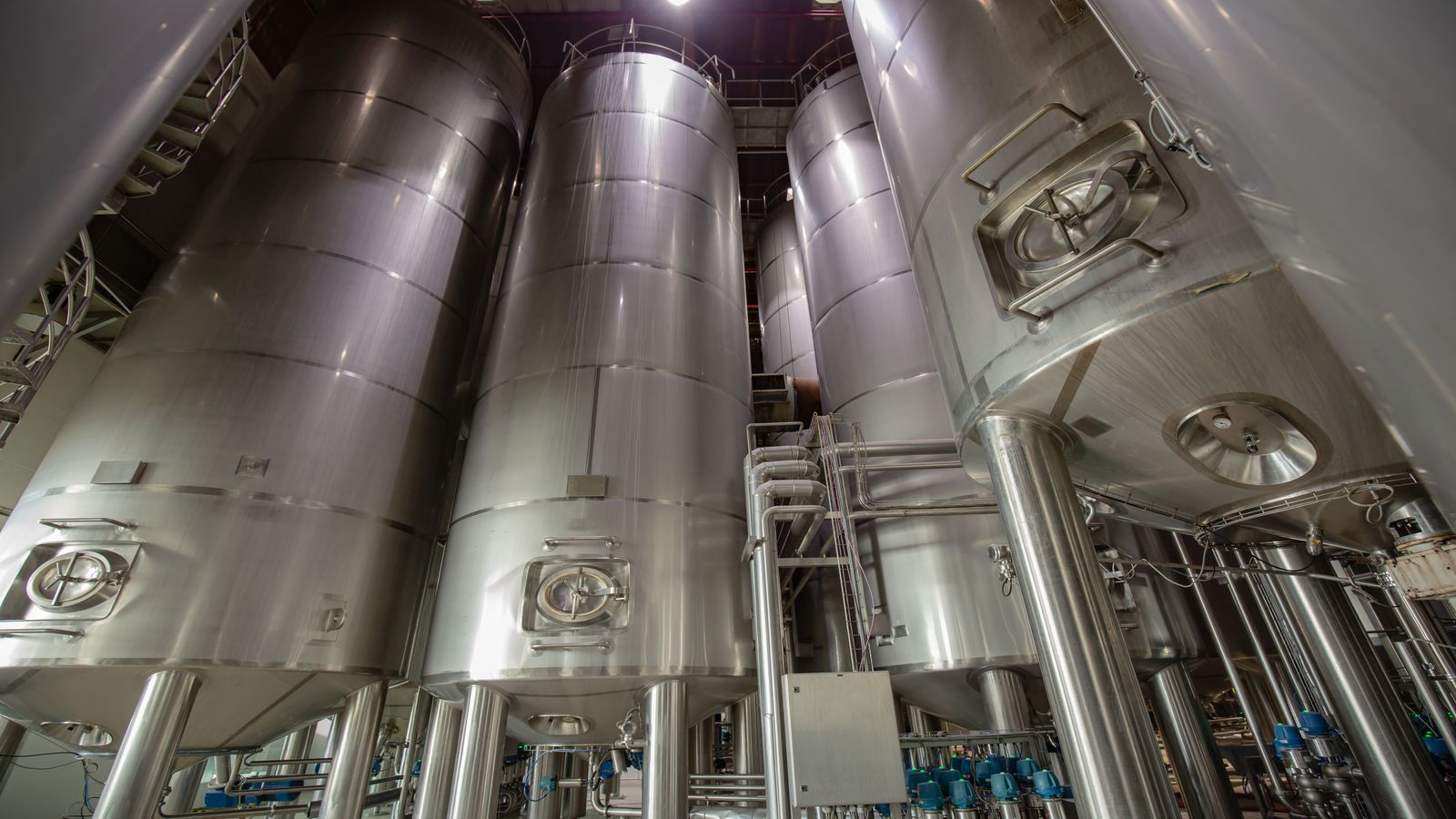
Buffer Tanks and Thermal Storage for Miner Heat: Stop Short-Cycling Your Greenhouse Heating
A miner produces heat continuously. A greenhouse needs heat variably. That mismatch creates a problem that most direct-duct heat reuse setups handle poorly. During the day, the greenhouse warms from solar gain and the miner heat is surplus. At night, heat demand peaks but the miner output has not changed. In a direct-air system, the miner is either dumping excess heat through the bypass during the day or falling short of demand at night. Neither is optimal.
Buffer tanks and thermal storage solve this. They decouple when heat is produced from when it is used. The concept is straightforward: capture miner heat in a thermal mass during periods of excess, then draw from that mass during periods of deficit. Domestic hot water systems have used this principle for decades. Applied to mining heat in a greenhouse context, it turns a lumpy, continuous heat source into something far more useful.
Why Short-Cycling Is the Real Problem
Before getting into tank sizing and plumbing, it is worth understanding what short-cycling does to a greenhouse heating system.
Short-cycling happens when a heat source turns on and off rapidly because the system has no thermal inertia. In a direct-duct setup without storage, if the greenhouse reaches target temperature, the bypass damper diverts miner heat outside. When the temperature drops a degree or two, the damper switches back. This can cycle every few minutes.
Short-cycling causes:
- Uneven temperature distribution. Rapid on-off cycling never lets the air temperature fully equalize across the growing space. You get warm zones near the inlet and cold spots at the far end.
- Humidity swings. Every time warm dry miner air floods the greenhouse, relative humidity drops. When it stops, humidity climbs. Rapid cycling creates humidity oscillation that stresses plants, especially seedlings and cuttings.
- Damper wear. Motorised dampers are not designed for continuous cycling. A damper that opens and closes fifty times a day will fail sooner than one that repositions twice.
- Control instability. Simple thermostatic controls struggle with systems that have no thermal mass. The hysteresis band of a standard thermostat (typically 1 to 2 degrees) is often too narrow for a direct-air system, leading to hunting.
A buffer tank gives the system thermal mass. Instead of reacting to every degree change in greenhouse temperature, the system charges and discharges a tank of warm water, smoothing the delivery curve.
How Buffer Tank Systems Work With Mining Heat
The basic architecture involves three stages:
Stage 1: Heat Capture
Mining exhaust heat is captured and transferred to water in a buffer tank. For air-cooled miners, this requires an air-to-water heat exchanger (essentially a radiator in the exhaust duct, with water flowing through it). For immersion systems, the dielectric fluid loop connects to a fluid-to-water heat exchanger.
The water in the tank gradually heats as the miner runs. A well-sized system aims to raise the tank temperature from a base of around 20 degrees Celsius to a working maximum of 50 to 55 degrees over the course of a day.
Stage 2: Storage
The tank holds the thermal energy until it is needed. Insulation is critical here. An uninsulated tank in a cold shed loses heat almost as fast as the miner puts it in. A well-insulated tank (100mm of mineral wool or equivalent) retains heat for 12 to 24 hours with manageable losses.
Stage 3: Delivery
When the greenhouse needs heat, a circulation pump pushes warm water from the tank through a heat delivery system inside the greenhouse. This can be:
- A water-to-air heat exchanger with a fan (a fan coil unit)
- Underfloor or under-bench heating loops (radiant)
- A combination of both
The delivery is controlled by the greenhouse thermostat. When the greenhouse temperature drops below the setpoint, the pump activates and delivers heat from the stored water.
Sizing the Buffer Tank
Tank sizing depends on how much heat you want to store and for how long. The physics are straightforward.
Energy stored in water: Energy (Wh) = Volume (litres) x Specific heat of water (1.16 Wh/litre/K) x Temperature rise (K)
Example: A 500-litre tank heated from 20 degrees to 50 degrees stores: 500 x 1.16 x 30 = 17,400 Wh (17.4 kWh)
A single 3,500-watt miner running for 8 hours produces: 3,500 x 8 = 28,000 Wh (28 kWh)
But not all of that reaches the tank. With air-to-water exchange efficiency of 50 to 65 percent (these exchangers are not highly efficient in this application), you realistically capture: 28,000 x 0.55 = 15,400 Wh
So a 500-litre tank roughly matches one miner's capturable heat output over an 8-hour daytime period. That stored energy can then supply greenhouse heating through the night.
Recommended Tank Sizes
| Number of Miners | Miner Wattage | Recommended Tank Size | Stored Energy (approx) |
|---|---|---|---|
| 1 | 3,000 - 3,500 W | 300 - 500 litres | 10 - 17 kWh |
| 2 | 6,000 - 7,000 W | 500 - 1,000 litres | 17 - 35 kWh |
| 3-4 | 9,000 - 14,000 W | 1,000 - 2,000 litres | 35 - 70 kWh |
These assume daytime charging with evening and overnight discharge. If you want multi-day storage (covering a cloudy cold spell while mining continues), increase the tank size proportionally.
Air-to-Water Heat Exchangers
For air-cooled mining setups, the heat exchanger between the miner exhaust and the buffer tank is the most critical new component.
Options:
- Automotive heater cores. Inexpensive, widely available, and reasonably effective. A large heater core (250 x 200mm face area) in the exhaust duct stream can transfer 1,500 to 2,500 watts to water, depending on airflow and temperature differential. For a single miner, two heater cores in series may be needed.
- Commercial duct-mounted water coils. Purpose-built for HVAC applications. More expensive (200 to 600 euros) but better matched to duct sizes and airflow rates. These are the right choice if you want reliable, maintainable performance.
- DIY copper-coil exchangers. Copper tubing coiled inside the exhaust path. Effective if you have soldering skills and patience. Difficult to get right and harder to service, but very cheap.
Key design point: The heat exchanger introduces airflow restriction in the exhaust path. The miner's fans must be able to push through this restriction without overheating. Measure the static pressure drop across your exchanger and compare it to the fan's pressure curve. If the exchanger is too restrictive, the miner will throttle or overheat.
Insulation and Standby Losses
A buffer tank only works if it actually holds its heat. Standby losses are the biggest practical concern for small systems.
An uninsulated 500-litre tank at 50 degrees Celsius in a 10-degree shed loses roughly 200 to 400 watts continuously, depending on tank surface area and ambient conditions. Over 12 hours, that is 2.4 to 4.8 kWh of wasted stored energy - potentially a third of what you charged into it.
Insulation standards:
- 50mm mineral wool: reduces standby loss by 60 to 70 percent
- 100mm mineral wool: reduces standby loss by 80 to 85 percent
- Commercial pre-insulated tanks (like domestic hot water cylinders): typically achieve 1 to 2 kWh loss per 24 hours for a 300-litre tank
If you are using a repurposed vessel (an old oil drum, a food-grade IBC), insulate it yourself with mineral wool batts and a vapour barrier. The cost is modest and the payback in preserved heat is immediate.
Control Strategy
A buffer tank system needs slightly more control intelligence than a direct-duct system, but not much. The basic logic is:
- Tank charging: If the tank temperature is below maximum (say, 55 degrees C) and the miner is running, circulate water through the heat exchanger.
- Greenhouse heating: If the greenhouse temperature is below the setpoint, circulate water from the tank through the greenhouse heat delivery system.
- Bypass: If the tank is at maximum temperature, divert miner exhaust through the outdoor bypass to prevent overheating.
- Low-tank protection: If the tank temperature drops below useful delivery temperature (say, 25 degrees C), stop the delivery pump and switch to backup heating.
This can be implemented with two thermostats and two circulation pumps. Nothing exotic. A dedicated greenhouse thermostat controls the delivery pump. A tank thermostat controls the charging pump and the bypass damper.
For more sophisticated control, a simple microcontroller (Arduino, ESP32) with temperature sensors on the tank and in the greenhouse can manage all four states automatically. Several open-source greenhouse control projects provide ready-made firmware for this.
Practical Considerations
Tank placement. Place the tank between the mining enclosure and the greenhouse, as close to the greenhouse as possible. Heat losses in the delivery piping are lower than losses in the capture side, so it is better to run a longer duct from the miner to the exchanger than a longer pipe from the tank to the greenhouse.
Freeze protection. If the tank or piping is in an unheated space, protect against freezing. Use glycol in the tank water (which reduces heat capacity slightly) or insulate and heat-trace exposed piping.
Water treatment. Stagnant warm water in a closed system can develop bacterial growth. Use a closed-loop system with inhibitor chemicals, or flush and refill annually.
Tank material. Stainless steel is ideal but expensive. Mild steel with an internal coating works. Plastic tanks rated for the temperature range (polypropylene, rated to 80 degrees C or higher) are the cheapest option and resist corrosion.
When Storage Does Not Make Sense
Buffer tanks add complexity and cost. They are not always justified:
- If your greenhouse heat demand closely matches the miner output profile (continuous, 24/7 growing operation in a cold climate), direct-air delivery may be sufficient.
- If you only run one miner and the greenhouse is small enough that direct ducting meets overnight demand without storage.
- If the capital cost of the tank system exceeds the value of the improved heat utilisation.
For further context on heat delivery layouts, see Bitcoin Mining Greenhouse Heating in 2026. For thermal calculations, see the heat reuse calculator.