Tulips, Tomatoes, and Cold Climates: Comparing 2026 Greenhouse Heat-Reuse Pilots
The number of people actually running mining heat into greenhouse spaces has grown from "a handful of hobbyists" to "enough to compare notes." Not a lot, but enough. What struck me over the past season was how different the outcomes are depending on the crop, the climate, and the operator's expectations. A tulip-forcing setup in the Netherlands and a tomato propagation shed in northern Canada are both using mining waste heat, but the resemblance ends there.
This is a comparison of what I have been able to learn from pilot setups running through the 2025/2026 season. Some of this is first-hand observation. Some is from correspondence with operators who shared their data. None of it is comprehensive enough to be statistical. Think of it as useful pattern recognition.
Tulip Forcing: The Most Natural Fit
Tulip forcing has specific thermal requirements that align remarkably well with mining heat output. Bulbs need a cold period (5 to 9 degrees Celsius for 12 to 16 weeks), followed by a forcing period at 15 to 20 degrees Celsius for 2 to 3 weeks to trigger rapid stem growth and flowering.
The cold period requires refrigeration or an unheated space, not mining heat. But the forcing period is where mining heat works. You need consistent, moderate warmth delivered at bench level for a relatively short period. One or two miners providing bottom heat to a forcing bench is a near-ideal application.
What works:
- Under-bench duct distribution delivers heat to the root zone, which is exactly where forcing tulips want it.
- The temperature range is forgiving. Tulips in forcing tolerate 15 to 22 degrees without quality loss. Mining heat delivery rarely needs to be precise to a single degree.
- The forcing period is weeks, not months. Hardware runs hard for a defined season and can then shift to other uses or shut down.
- The economic case is straightforward: forcing tulips out of season commands premium prices, and the heating cost is a direct input.
What does not work as well:
- Humidity control. Tulip forcing spaces need controlled humidity to prevent Botrytis. Mining heat is dry, which is helpful for reducing fungal pressure, but it also dries out the root zone faster. Growers report needing to water more frequently or add localised humidification for the foliage.
- Scale mismatch. A serious forcing operation processes thousands of bulbs. One or two miners provide enough heat for a single bench or a small forcing room. Scaling mining heat to a commercial forcing operation requires many miners, and the infrastructure becomes a project in itself.
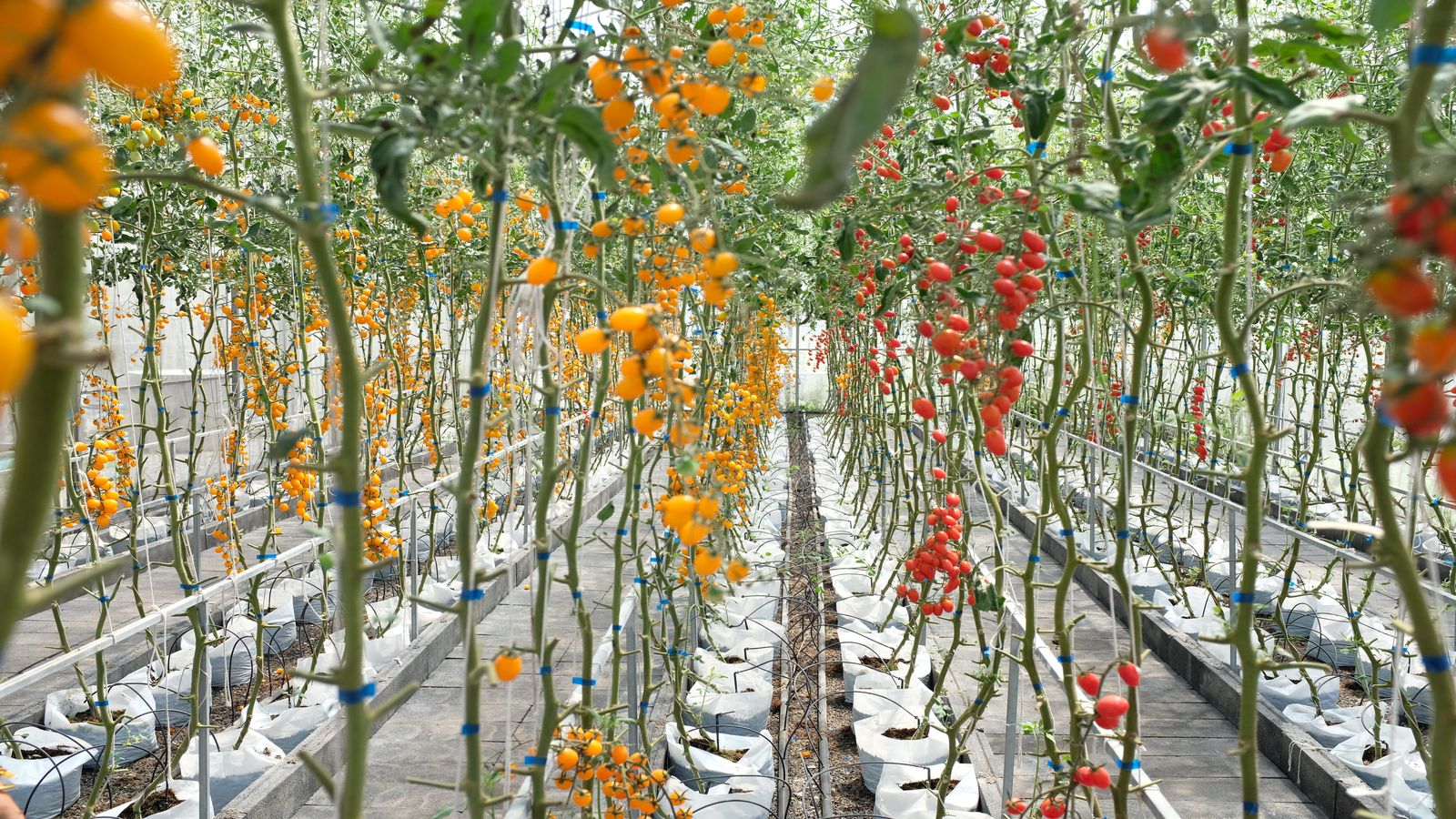
Tomato Propagation: The Fussier Case
Tomato propagation has tighter temperature requirements than tulip forcing. Germination wants 24 to 29 degrees Celsius, and seedling growth needs 18 to 24 degrees with good light. Night temperatures should not drop below 15 degrees. Tomatoes are also more sensitive to temperature swings than tulips.
Several operators in Canada and Scandinavia have tried using mining heat for tomato propagation houses. The results are mixed.
What works:
- Mining heat as a base-load supplement. In cold climates where the greenhouse would otherwise run a propane or oil heater for six months, mining heat can offset 30 to 60 percent of the heating bill. The conventional system still handles precision control and peak demand.
- Under-bench root zone heating. Tomato seedlings respond well to bottom heat, and mining heat delivered at bench level improves germination rates and early growth compared to overhead heating alone.
Where it gets complicated:
- Temperature precision. Tomato seedlings suffer when temperature swings exceed 5 degrees within an hour. A direct-duct system without thermal storage creates exactly this kind of swing when the miner cycles or when the bypass damper operates. Buffer tanks are effectively mandatory for tomato propagation applications.
- Night coverage. Tomato propagation needs reliable overnight heating. If the miner goes down for maintenance at midnight, you lose your heating source. Having a redundant conventional system is not optional; it is essential.
- Humidity interaction. Tomatoes are susceptible to several humidity-driven diseases (late blight, leaf mould). The dry air from mining heat can help manage humidity in wet conditions, but it can also stress plants if the greenhouse is already well-ventilated. The interaction is crop-specific and site-specific.
Cold-Climate Propagation: The Harsh Test
The most ambitious pilots I have seen are in genuinely cold locations: interior British Columbia, northern Finland, and central Norway. These are places where outdoor temperatures sit at minus 15 to minus 30 degrees Celsius for weeks, and greenhouse heating costs are the dominant operating expense.
At these temperatures, the thermal demand overwhelms what a few miners can supply. But the mining heat contribution is still valuable because every kilowatt-hour of mining heat is a kilowatt-hour of propane or electricity you do not buy.
What the cold-climate operators report:
- Mining heat provides 20 to 40 percent of the total heating demand in deep winter, depending on greenhouse size and insulation.
- The remaining 60 to 80 percent comes from conventional sources. Nobody in these climates is heating solely with miners.
- Duct losses are higher because the temperature differential between the duct interior and the outside air is larger, even with insulation. Duct runs need to be as short as possible, ideally through heated intermediate spaces.
- Condensation and freezing inside duct runs is a real risk when outdoor temperatures are well below zero. Insulation quality and backdraft prevention are critical.
- The economic value is highest in these locations because the fuel cost being offset is highest. Several operators report that the fuel savings from mining heat pay for the duct infrastructure within a single winter season.
Comparing the Crops
| Factor | Tulip Forcing | Tomato Propagation | Cold-Climate General |
|---|---|---|---|
| Temperature precision needed | Low (15-22C range) | High (18-24C, tight overnight) | Moderate (frost protection) |
| Thermal storage required | Optional | Strongly recommended | Recommended |
| Mining heat as sole source | Feasible for small bench | Not recommended | Not feasible |
| Humidity sensitivity | Moderate (Botrytis risk) | High (multiple diseases) | Varies by crop |
| Economic case | Strong for premium forced flowers | Moderate, depends on fuel prices | Strong where fuel is expensive |
| Duct loss concern | Low (short runs typical) | Moderate | High (extreme delta-T) |
What the Pilots Do Not Tell You
The pilot reports and operator notes I have seen share a common gap: long-term maintenance data. Most of these setups have been running for one or two seasons. The duct cleaning schedule, fan replacement cadence, heat exchanger fouling rate, and hardware degradation in high-humidity adjacency are all unknowns at this point.
I suspect that the second and third years of operation will reveal the real costs. The infrastructure that is cheap to build may be expensive to maintain. The miner that performs perfectly in year one may need board replacement in year two because the greenhouse environment accelerated corrosion. The duct run that was efficient when clean may lose 15 percent of its airflow to dust and biological growth by the end of the second season.
This is not a reason to avoid heat reuse. It is a reason to plan for maintenance from the start, monitor system performance continuously, and not assume that the economics of year one will persist indefinitely. See our guide on ventilation, humidity, and corrosion for the environmental hazards in detail.
What Changed My Thinking
Before seeing these pilots, I thought the ideal heat-reuse crop was something with high value and continuous heating demand. Tomatoes, peppers, cucumbers: year-round greenhouse crops with significant thermal needs.
After comparing notes with operators across several climate zones, I have shifted. The ideal heat-reuse crop is one with moderate temperature tolerance, a defined heating season, and high value per unit of floor space. Tulip forcing fits that profile better than year-round vegetable production, at least at the small scale where most Bitcoin miners operate.
The year-round crops need year-round reliability, precision control, and backup systems that add complexity and cost. The seasonal crops let you run hard for a defined period, tolerate wider temperature bands, and do not punish you as severely for a 2-degree overshoot at 3 AM.
For the layout decisions that make these setups work, start with Bitcoin Mining Greenhouse Heating in 2026. For thermal storage, see Buffer Tanks and Thermal Storage for Miner Heat.